"Help Me, I'm Starving"
Some comments on psychosis

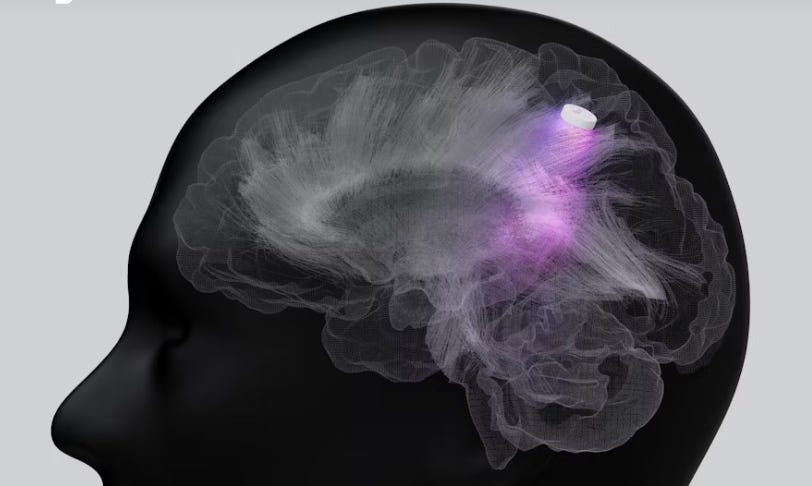
Writer’s note: for the newsletter readers, you should actually click the headline and read it online rather than within the newsletter, as, for me, publishing an essay works as a forcing function for clearer editing for some reason (meaning you’ll read the most recent version if you read online, not within the newsletter).
Have you ever spent a few weeks thinking the past twelve years were entirely false traps intended to humiliate you and display your worthlessness as a human? Every job—fake, every romantic relationship—fake, and all your so-called friends actually united in their hatred for you (while conspiring to bring you down)?
Probably not. And that’s good. But what I’m describing is but one possible psychological output of the mental state called “psychosis.” Psychosis is, granted, a Pretty Scary Word, not least for the axe-murderer connotation of the root of the word (“psycho”). But psychosis is one of those things rarely talked about, thus even less understood, by outsiders as much as those who’ve experienced it. And it’s a tremendously disorienting experience for everyone involved.
So I wanted to write about psychosis, as someone who’s experienced it multiple times, critically enough to warrant psych hospital visits basically each time to get squared away. It’s a bit of a vulnerable topic to put pen to paper on, but given this latest bout with it (and increasing, not decreasing, psychosis trends in the USA) it felt important to try to contribute a little bit of a primer to this perplexing conversation.
1.
What is psychosis?
Let’s start by noting that the human mind is impossibly complex. Not just the brain—any computational neuroscientist can tell you that—but the mind is impossibly capable at taking the play-doh of facts and events and characters and shaping them into interpretations that end up, cumulatively, rendering wrong and scary visions of reality.
By reality here, I don’t mean it in a hand-waving philosophical way—I mean as simply as “what’s happening” or “what’s going on.”
Psychosis technically means a “break from reality,” but it should really mean “deep immersion in your own reality.” Normally we can assume some reliable correspondence between outside phenomenon and inside interpretation. But in psychosis, the inner world becomes a black hole, warping the incoming light of experiences at its event horizon to become something quite different when experienced by the inside Self.
As gestured at already, the main way you break from reality is a hijacking of your interpretative ability—what things mean, the context window. If Event X most plausibly means Y (in light of all available context and history), your mind instead interprets it as Z (using its own context and history, which likely skews odd). And Interpretation Z is likely consistent with a new Main Narrative of what’s going on, rather than consistent with whatever prior Main Narrative anchored and oriented your thinking with respect to the thing being considered.
We take for granted our brain’s trustworthiness in rendering accurate understandings of what’s happening. What’s especially pernicious is that as comprehensively as you currently feel you have a truthful lens you’re seeing the world through, that’s how truthfully and comprehensively the person in psychosis can feel about their interpretive eyeglasses as well. The interpretations feel like the truth, in other words—deep sanity, rather than insanity.
Once sparked, it can spread like a contagion or wildfire through the memory—so recent events and conversations become re-coded, from neutral to threat, for example, or an offhand recent text message, or billboard, or whatever, gets mysteriously and automatically reinterpreted in a way that illustrates the new narrative. A memory from ten years ago becomes remembered and reinterpreted as part of “what’s going on” now—as further evidence that the plot goes deeper than you could’ve imagined. And so on.
It’s hard to convey quite how quickly the mind can cascade through memories to reinterpret events via its new lens. Thus the earliest phases of psychosis actually feel like an extended epiphany, one after the other, representing a dawning and horrifying new reality that feels accurate. That’s the crux worth conveying: you don’t feel crazy, you feel newly enlightened, newly clued in to what’s actually been going on.
What doesn’t help is that you become extremely sensitive to art and other created artifacts—to signs on the wall, to songs, to dialogue in movies, even just overheard conversations. I’ve never had psychosis alone in a jungle before but I have to imagine it’s a significantly less distressing experience than in a more symbolically-dense environment like a city or hospital—where there’s not movies with music with lyrics that could be snatched by your mind and interpreted as a new accusation or as a new hint to what’s been going on.
That word “hint” is key. You’re infinitely suggestible in a state of psychosis, meaning you’re also super attentive to others and your environment. You read body language 10x more closely than usual. And since you’re usually saying and doing uncomfortable and alarming things, you’re accurately picking up that others are uncomfortable or alarmed to be around you—which piques your threat-detector even further, making you even more paranoid, in a vicious cycle.
One friend described a brief bout with mushroom-and-cannabis induced psychosis as “paranoia without reason.” Another friend described a similar LSD-induced psychosis as being “unable to break out of the new narrative.” These are both apt and accurate descriptions. And to willfully choose to see things “inaccurately” (i.e., the actual real way you’ve always seen things) feels like a leap of faith that risks foolishness—which feels legitimately dangerous when in psychosis, especially one shaped by a paranoid, persecutory, or accusatory new narrative. To get it wrong is to risk threat, which keeps you (reasonably) locked-into your new narrative for self-preservation’s sake.
The ultimate reason is that your reasoning faculties have been compromised—you’re reasoning all right, but reasoning to give yourself evidence of the new narrative you can’t break out of, not to interrogate or ask how likely the conspiracy is.
So that’s psychosis—wrong dot-connecting, then wrong seeing, then wrong thinking and subsequent wrong speech and behavior. Then things start getting… weird.
2.
When we’re in our “right mind” (“wrong mind” would be a good description of psychosis, actually), we don’t take in inputs from our experience and output conclusions like this:
Interpreting abrupt fluctuations in your body temperature (real reason: drugs wearing off) and the weather outside (real reason: it’s the hinge of Fall to Winter) to mean you’ve actually been uploaded into a computer whose controllers intend to punish you across a thousand lifetimes. That degenerate Nick Fuentes’ line around the 2024 Election—“Your body, my choice, forever”—becomes remembered and reinterpreted to mean my body, my enemies’ choice, forever, and the only way to assert any type of control is to cut my own wrists. (Thankfully I didn’t, but it was within moments of going either way)
Looking at your abundant book collection and deriving an antagonistic meaning from each title about how you were surreptitiously guided to purchase each book to your own self-incrimination (“Briefing for a Descent into Hell” by Doris Lessing becomes a condemnation of your worst moments, “Pity the Nation” becomes an indictment of how you never really tried to understand the Middle-East well enough during your so-called interested phase in the region, etc., etc.)
Songs from childhood come to mind and you realize you never listened to the lyrics, so you look-up the lyrics to these songs (which you’re certain are being sung sub-audibly by cochlear implants in your eardrums, surgically added by your “enemies” at some point in the preceding months while you slept) and notice each has an exceedingly apropos-feeling application to your current situation (and also typically involve dying)
Wholesale considering all your professional work fake: false setups to get you to a place of stability and then torn down from you one after the other over a decade
While testing whether you’ve been uploaded into a computer or simply in an induced lucid dream, you Perplexity how to wake up from a lucid dream. One suggestion is to spin in tight circles till dizzy, and you recall a close friend (now mortal enemy of course) sending you a video of himself doing a whirling dervish in the afternoon during a playful afternoon with his wife, and you think maybe he was sending you a clue about how to wake up from the impending death coming your way—so you head out to the backyard at 2am and spin in circles, over and over, until you’re falling over from dizziness repeatedly
Leaving your car out of gas in the middle of an intersection at 1:00am in the suburb of Dallas you’re living in, because you naturally thought when it ran out of gas that someone (an enemy of some kind) had triggered a killswitch on your car instead, to prevent you from escaping anywhere
Following people in an airport—meaning, standing near them, ultimately chasing one until I was tackled and was forcibly sedated by paramedics—because a book you’re reading somehow suggested, in the fog of psychosis, that this would make the sense of threat and impending doom stop
I could keep going but, you get the idea. My point is simply this:
When you hear about people who “go crazy” and kill their spouse or whatever, psychosis is what you’re talking about.
When you hear about the “insanity plea” in legal proceedings, psychosis is usually what you’re talking about.
When you see homeless people half-naked screaming at trees with a machete in their hand, psychosis is what you’re talking about.
In short: psychosis is scary stuff. Something as simple as thinking distortedly makes people do profoundly bizarre things, especially because so many psychosis patterns tend to hew toward paranoia about conspiracies against you. If you feel embattled, you’re scared—and scared people do absolutely crazy things.
I’ve personally (like, two weeks ago) tried to scale an outdoor brick wall at a mental institution to escape what I thought was certain impending torture. I also jumped over the nurses desk in the unit to try to escape through a back-door, running straight past a startled nurse who’d apparently never seen anyone hurdle the desk like that.
If you’re clear-sighted watching either of these things happen, you’d think: wow, that guy’s crazy. Whereas if you had the full context of what was being thought (and specifically what fears were motivating the behavior), it’s actually quite rational. That’s what’s so pernicious and perplexing about psychosis: it’s a poisoned rationality, a confused rationality, powering confused and distorted thinking and behavior.
3.
I’d be remiss to describe psychosis’ problem without describing the venue typically remedying it. That is: what is a psych ward like?
At the outset I want to say my goal in describing a psych ward isn’t voyeuristic exhibitionism. Rather it’s simply a window into a world you’ll likely never encounter—one no one really encounters, besides the handful of employees there and those unlucky enough to require a stay. So here’s a few impressionistic memories blending a few different visits:
A naked man running down the hallway, occasionally, once clothed, asking in whispers where his wedding ring went from inside his room as you walk past his room in the hallway
A tall woman with a blank face splashing her face repeatedly from a small cup of water, then following people to intently and angrily stare at them
At least one absolute freak-out per-day by one of the residents—screaming to be released from the psych ward, how they don’t belong there, how they want to leave
There’s nothing to really do—basically just movies and television shows on the TV you don’t have the ability to choose (Marvel movies, Zorro, Prison Break), which, while within psychosis, bring hidden messages and distort your thinking even further
A woman begins screaming and drawing in colored marker on the walls “HELP ME IM STARVING” and “YOU HAVE THE RIGHT TO NOT BE ABUSED OR NEGLECTED,” along with colorful doodles, down the entire length of the long hallway of residences
This gives you some small sense of the chaos, disorder, and confusion of the environments containing patients in mental institutions. My take is that these places basically exist to keep you and others protected while the medicine can work its magic. And magic it is: I’ve got a 100% win rate of being brought back from psychosis by a few days of patient medicine-taking, which is crazy given that the first time you begin taking meds often feels (from within psychosis) like a self-defeating violation or betrayal of what you’re seeing or learning. But the medicine I hear is often effective for people (if the staff can persuade them to take it), and for that we owe modern pharmacology a major pat on the back.
4.
Lastly: do we understand psychosis?
Cate Hall mentions something in a now-taken-down podcast with Liv Boeree about her own experience with (sounds-like-LSD-induced) psychosis over several months, something to effect of “other cultures, including indigenous ones, have other, more sympathetic understandings of what’s happening in psychosis than our Western model.” Whether that’s true or not, it probably is true that we don’t fully understand what’s happening in psychosis given how comprehensively it can re-shape your perspective and how widely you can begin to see things previously invisible to you. Here’s two examples why.
Once you’re back to the shores of sanity, there’s still often coincidences that don’t make a lot of sense. For example, at one point in psychosis I’d said to someone “I don’t see the point in being a hero now that I see that everyone’s against me,” a usage of the term “hero” I wouldn’t normally use—and then the specific unit of the mental hospital I’m placed two days later at is named Hero Hall. What’s up with that?
Or one thread of my most recent psychosis was a sense that several films I’d watched recently had been inspired by my less pleasant choices or character defects (such that I was, mysteriously from Dallas, a type of muse to these directors and screenwriters). When the police showed up, one’s last name stitched on his uniform was “Muse”—which elicited my polite cooperation given the certainty that his appearance was “part of the plan.”
Simple coincidences, you might say—but what psychosis teaches you is that life is simply rife with coincidences, with possible connections: we normally just tune them out as irrelevant or don’t notice them to begin with. But psychosis is a state of superawareness—you’re hyper-vigilant, which makes it easy to notice patterns you wouldn’t normally notice, which I posit wouldn’t be possible if there weren’t already lots of possible things to notice to begin with. And lots of these patterns aren’t quite as easily hand-waved away as “mere coincidences.”
I’m intentionally keeping examples sparse here because the actual essay I want to research and write is that one (specifically: how do other cultures interpret and make space for experiences typically dubbed psychotic within Western DSM-led cultures), and this essay felt preliminary to introduce that one. So, stay tuned for more on that.
Fin
Studies tracking psychosis over the past decade indicate that the incidence of psychosis not otherwise specified (NOS) has increased from 30.0 to 55.1 per 100,000 individuals—an 83.7% rise in the post-legalization-of-marijuana era compared to pre-legalization.
And among young males aged 19-24, the proportion of schizophrenia cases associated with cannabis use disorder (PARF) more than doubled from 8.5% to 18.9% between pre- and post-legalization periods.
There’s all kinds of ways your noodle can get temporarily baked, and beyond my immediate story here, these are just a couple datapoints to substantiate that. Specifically, marijuana use (including those dumb cannabis and delta-8 pens) is a notoriously slept-on source of psychosis, given its ubiquity and reputation as safe. The ultimately distressing thing is that the substance-induced psychosis trends are increasing, not decreasing: meaning more people than usual will begin to experience what I’ve written about, not less.
So I want to say here at the end: if you have a loved one struggling with psychosis, please take overt and prescriptive action on their behalf to get them the help they need from an emergency mental hospital. Psychosis is a particularly obstinate state of mind, stubborn to the max, and those within it are least able to see its own insanity—so you can’t count on them to participate in their own help. Settle for “they’ll thank me later” based on forcing help upon them, instead of the very real possible regrets of a negative outcome (suicide, harming others). Psychosis is ice-cold serious, and most recently I owe Heather W. my life (legitimately) for forcing help on me as I dissolved into risky unreality. So, thank you Heather, with all my heart.