Rajneeshpuram
Four lessons from the commune the U.S. government destroyed

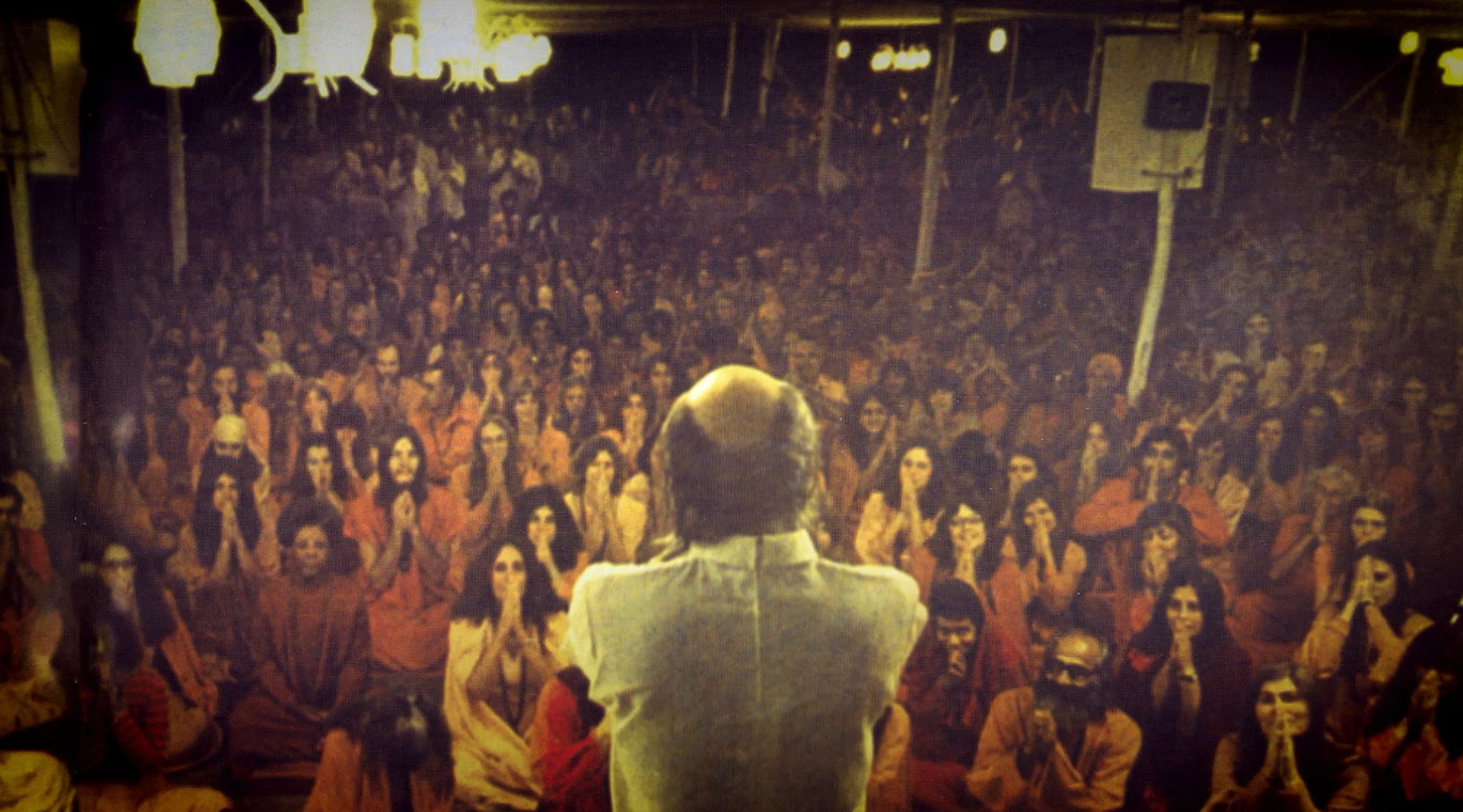
This is part ten in a series about societies—rather than businesses or governments—that have made a meaningful impact on the world. See all installments listed at the bottom of this essay, and see The Society Builders most recent intermission piece here.
I used to think “cult” was just the pejorative given to any group one didn’t like. But that’s just because I hadn’t watched Wild Wild Country. So, now I know: there’s actually a thing called a cult, and it’s not just a wacky bunch of pals.
Wild Wild Country is a 6-part documentary that’s actually a great gift for would-be society-builders. It hits so many themes that are common across IRL communities as they form, scale, and evolve. So we’ll take a closer cautionary look at what’s worth extracting from their story, but first let’s unpack the nature of their group a bit more.
Quick Intro
Rajneeshpuram was an early-1980’s commune—a startup society built on 64,000 acres in a remote part of Oregon—that had a dramatic rise, tenuous pinnacle, and then ignominious fall at the hands of the US Government.
“Raising the world’s consciousness (beginning with ourselves) is good.” That’s their One Commandment: the best summary one can probably make of what Rajneeshpuram was all about.
The documentary does a terrific job of telling the story as told through its inner circles’ eyes. With such access, the viewer enters into the subjectivity of the two sides across all the moments where there were “two sides”—first, Rajneeshpuram vs. City of Antelope residents, then Rajneeshpuram vs. US Government. Like a good novel, you get the ambiguous sense of the situation, the difficulty of saying concretely who’s fully in the right or who’s in the wrong. You hear actual humans seeing actual events from radically different—even irreconcilable—perspectives. And with that, you glimpse the reality of human society and politics.
You should watch it. But it’s long. And you’re busy. So, as second best, let’s dive in on the four most important insights for society builders from Wild Wild Country.
1. High-Agency Communities vs. Low-Agency Ones
Let’s give credit where credit is due: it’s evident that most communities aren’t remotely as agentic as the Rajneeshees were. Imagine if your local meditation group built a literal city in the middle of nowhere, complete with airport, sewage system, residences, and police force. That’s basically what the Rajneeshees achieved, in a mere matter of three years.
And set aside the Rajneeshees effectiveness at city-building (since most communities don’t aspire to build a city). Most communities aren’t even as effective at communicating their vision (and recruiting thereby). And recruiting members is something almost every group considers part of their core purpose.
So the Rajneeshees weren’t just unusually effective at expressing their community into IRL forms like a city. They were unusually effective at recruiting, too, ultimately gathering 7000 people within Rajneeshpuram.
2. If Building IRL, Manage Relationships with Locals
Even a town of 100 people like Antelope, Oregon—where Rajneeshees selected for Rajneeshpuram—is enough to contest your presence if they don’t want you there. 100 people doesn’t sound like a lot? Watch the documentary.
So, for example, if you’re building a free-love commune inflected by teachings that’re totally antagonistic to your neighbors’ predominant faith commitments… then it would behoove you to learn ahead of time about your eventual neighbors, because they may ultimately start to oppose you at every turn.
Note: pushback here doesn’t just mean “say mean things.” The conflict literally escalated to each community weaponizing in fear of the other—both framed as “defense,” and as responsive to aggressions by the other side. Then consider the sheer number of territorial disputes across the world’s history: Antelope’s crisis isn’t an isolated issue, it’s simply a microcosm.
3. Idea Societies vs. Charismatic Societies
Societies built around ideas operate differently than societies built around charismatic leaders. If there’s a general heuristic, it’s that charismatic-led communities are convergent, whereas idea-led communities are divergent.
In the Rajneeshees’s case, their attention and activities converged around Osho, their leader. He shaped their spiritual practices and provided the main answer for why any given Rajneeshee was there: “Osho.”
This creates an obvious risk: if your leader goes awry, your community can go awry. And this was evident through the step-by-step escalation and aggression by Osho’s deputy, named Sheela, against their enemies.
On that note, I had the same sense watching Wild Wild Country as I did watching the two documentaries about Fyre Festival: that is, if only a few things had gone right instead of wrong, these documentaries wouldn’t exist at all, because things would’ve stayed fine. And they were fine for quite awhile!
But if a strength of idea-led communities is their interpretive competitiveness—their constant intra-group competition of which forms, rules, practices express the ideas best, leading to the divergence I referenced earlier—then a strength of the charismatic-led community is the sheer magnetism of the leader. And who the leader deputizes can turn out to have unexpected influence on the eventual path of the community.
4. Persuasive Moral Slop as Lingua Franca
Wild Wild Country is interesting because you end up watching six of hours of content with basically the same handful of people narrating the story. And one thing that becomes super apparent is how the leadership at Rajneeshpuram speaks sophistry like its their native tongue.
I don’t mean they’re trying to be intentionally deceptive—they’re not. I mean the way they speak is textbook persuasive moral slop: assertions not arguments, reframing rather than explaining, blaming rather than addressing steelmanned concerns head-on.
Picture a classic press conference, with a slightly-antagonistic press and a media-trained interviewee: declarative statements, boldly asserting their frame, casting their opponents in the worst light and the situation in the most favorable light to themselves. Rajneeshpuram’s leadership, from Osho down, speaks like that in real life, about everything.
It’s interesting because despite its ability to connect ideas with values and cohere ideas with other ideas, persuasive moral slop basically isn’t a rhetorical style usually intended to build bridges: rather, it usually fortifies existing barriers, and battens down the hatches in competitive contexts.
So I found myself wondering how differently things might’ve gone for Rajneeshpuram had Sheela’s default mode of conversing not been such impenetrable persuasive moral slop. It’s quite plausible to me that Sheela’s intensely antagonistic rhetorical style poisoned relations with the community (and public writ large) so badly that it singlehandedly altered the course of the community’s path, from “default safe” to “default endangered.”
Conclusion
I found Osho himself pretty unimpressive: his teachings, his will-to-power, his seduction by opulence. Yet the Rajneeshees consistently speak of Osho’s charisma and humane beauty. So I wondered to myself whether the filmmakers maybe intentionally shielded viewers from this charisma—whether they’d seen too much about his way with people, and slanted their artwork to protect viewers from it. After all, there’s plenty of stories of art accidentally catalyzing movements instead of warning people away (Michael Lewis’ memoir Liar’s Poker and the film Wall Street were two examples from the world of finance).
You can’t help but have some empathy for those who participated in the commune: their reverence for Osho, their admiration for the society they’d built, their mourning for the paradise lost is both palpable and surprisingly sad.
The documentary, released in 2018 to much fanfare, should probably be considered required viewing for anyone who’d build new societies. It’s just too beneficial as a cautionary tale: a community that realistically could’ve probably been of some benefit to the world, but flew too close to the sun.
Table of contents for The Society Builders series:
Alcoholics Anonymous: How AA invisibly built the most influential decentralized society in world history
The Clapham Circle: How 12 families in a London suburb abolished slavery
The Mondragon Corporation: A historical blueprint for cooperative capitalism (with a crypto lens)
MSCHF (aka Mischief, aka Miscellaneous Mischief): How to create a venture-backed art society that creates subversive culture
The Network School: Dispatch from the Malaysian ghost-city startup society (that bootstraps startup societies)
IBM: What their 1937 Song Book says about a bygone era of Corporations-as-Societies
The Society Builders: An Intermission—A quick essay for reflection, synthesis
The Fellowship: A cautionary tale of the secretive Washington DC “politico-religious” society
Rajneeshpuram: 4 lessons from the commune the U.S. destroyed
The NYC Italian Mafia: The promise and perils of “quick and quiet coordination”
San Francisco House of the Latitude: Why the modern secret society failed (and what it was missing)